« Softmax Gradient Policy for Variance Minimization and Risk-Averse Multi-Armed Bandits » presented at 12th AIS conference, Sept 2026

This is a talk presented at AIS conference 2026 held Sept 21-24, Italy.

Talk materials: the slides of the presentation.

Abstract. Algorithms for the Multi-Armed Bandit (MAB) problem play a central role in sequential decision-making and have been extensively explored both
theoretically and numerically. While most classical approaches aim to identify the arm with the highest expected reward, we focus on a risk-aware setting where
the goal is to select the arm with the lowest variance, favoring stability over potentially high but uncertain returns. To model the decision process, we consider
a softmax parameterization of the policy; we propose a new algorithm to select the minimal variance (or minimal risk) arm and prove its convergence under natural conditions. The algorithm constructs an unbiased estimate of the objective by using two independent draws from the selected arm’s distribution. We provide numerical experiments that illustrate the practical behavior of these algorithms and offer guidance on implementation choices. The setting also covers general risk-aware problems where there is a trade-off between maximizing the average reward and minimizing its variance.


Agentic AI Summit 2026 (August 1-2 @ UC Berkeley)

Agentic is moving fast, second conference had record attendance, 5k in person and over 100k online.

Here is my poster presented at the Agentic AI Summit 2026 (August 1-2 @ UC Berkeley) on

« Vector-Quantized Geodesic Trajectories as Skills for Spatial Aware LLM-Driven Agents », PDF link here

Presentation Abstract
LLM-based agents are often criticized for lacking spatial understanding and mainly exploiting statistical text patterns. We investigate their spatial comprehension through an architecture combining geometrical tools with a large language model serving as a high-level orchestrator in grid-world environments. The agent first collects geodesic trajectories, which are then vector‑quantized to extract a representative subset. Each resulting trajectory defines a reusable skill (tool) that outputs spatial metrics such as the remaining distance to the target and local geometric information, including nearby obstacles. The LLM is used offline to interpret the learned skills by projecting them into natural language descriptions of the underlying behavioral patterns. Online, the LLM chooses the appropriate skill conditioned on the current state and goal. Low-level control is handled by primitive actions that execute the selected skill. From an agentic AI perspective, this approach separates learning into two levels. Skill discovery is handled through unsupervised quantization of trajectories, while reasoning and decision-making are handled by the LLM. New skills emerge when trajectories contrast from the existing ones (implemented technically a signed measure vector-quantization). Further investigations can help assess applicability, robustness and effectiveness for sequential decision-making settings such as robotic manipulation or navigation in partially observable or higher-dimensional environments.

« Stiff deterministic and stochastic systems in physics and finance: Physics Informed neural networks and Onflow portfolio management » presented at DSP 2026, feb 2026

This is a talk presented at DETERMINISTIC AND STOCHASTIC PROCESSES conference held at the Apollonia University Iasi together with the Romanian Acadmy of Science (Iasi branch), Feb 25-28 2026.

Talk materials: the slides of the presentation.

AI4-MED: Personalized Medicine in the Era of Artificial Intelligence


Took part recently at a round table on AI in medecine within the AI4-MED conference. Several subjects were touched including the concerns, the safeguards, the trust in complex situations. More detailed reproduction of the discussion will follow on another outlet.


Deep hedging at FAAI 2025

During the FAAI 2025 conference I presented a recent work with Pierre Brugière on . See here the paper (arxiv version)  and here the slides.

Executive summary: we introduce a deep-learning framework for hedging derivatives in markets with discrete trading and transaction costs, without assuming a specific stochastic model for the underlying asset. Unlike traditional approaches such as the Black–Scholes or Leland models, which rely on strong modeling assumptions and continuous-time approximations, the proposed method learns effective hedging strategies directly from data. A key contribution is its ability to perform well with very limited training data—using as few as 256 simulated price trajectories—while outperforming classical hedging schemes in numerical experiments under a geometric Brownian motion setting. This makes the approach both robust and practical for real-world applications where data and model certainty are limited.

Fake news sites: generative AI left unckecked

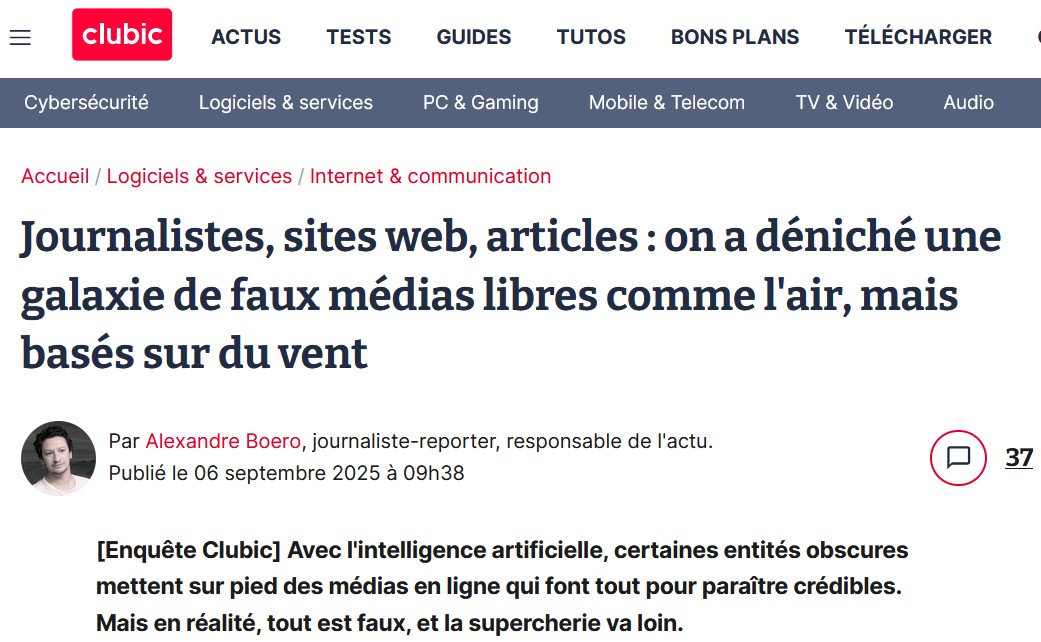
In a recent interview with Alexandre Boero from Clubic we discuss how recent technologies rendered possible a growing network of fake online media sites and journalists entirely generated by AI, designed to appear credible and manipulate audiences and advertisers, raising serious concerns about misinformation and the erosion of trust in digital content.